
 LU konference
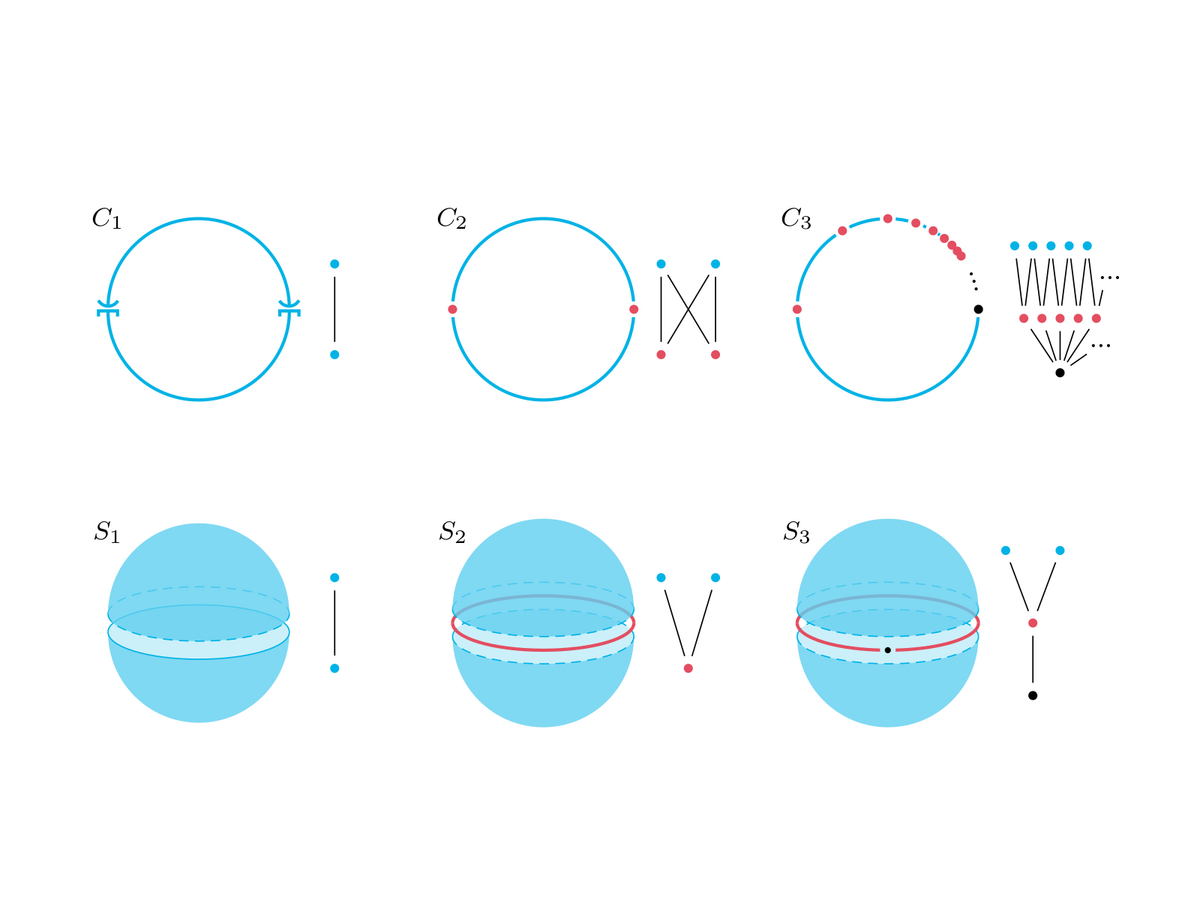
Photo: 1. Simple three-dimensional topological spaces (tetrahedra) partitioning into lower-dimensional spaces. Topology, as a subfield of mathematics, deals with characterizing and understanding spaces by connecting simpler, smaller spaces together.
2. Topological partitioning of circles and spheres in various ways (stratifications). A circle can be characterized using open and closed intervals, as well as individual points between them. A sphere can be formed using a circle by attaching two circles to it, one from each side.
One of the projects at the University of Latvia's Faculty of Medicine and Life Sciences Clinical and Preventive Medicine Institute, which focuses on AI training and development, is AIDA – an artificial intelligence-based diagnostic assistant for detecting stomach inflammations, which could help identify stomach cancer or various precancerous conditions. In the project countries – Latvia, France, Spain, Lithuania, and Portugal – data is being collected consisting of tissue images with various precancerous or cancerous conditions, where experts, pathologists, have marked areas where cancer or precancerous cells are visible. These files are then analyzed by AI, which "learns" by comparing images of tumors with those without. Based on the processed information, a model is created that AI will subsequently use to recognize cancer cells. The more samples collected, the better the AI will become. After more than a year of successful collaboration between LU MDZF KPMI and researchers from the Institute of Electronics and Computer Science, AI recognizes tumor-affected cells with 92% accuracy in a simple task.
Improving the results obtained by AI is one of the challenges faced by scientists worldwide, as there is currently no single method to enhance the accuracy of its algorithms. Therefore, in the postdoctoral project, based on the knowledge gained from the development of AIDA models, a topology-based approach will be developed. "The AI algorithm used to analyze these images still has some shortcomings – when receiving an image, it tries to decipher which tissues are healthy and which have pathologies. Sometimes it succeeds, sometimes it does not. Possible shortcomings may be related to the fact that the algorithm analyzes the image in parts that should be combined. Therefore, mathematical topology could be used here to connect one part of the image with another and perform calculations so that they have similar results combined across all parts," says researcher, mathematician Jānis Lazovskis from LU KPMI. The analysis of mathematical topology data could significantly complement and improve the artificial intelligence approaches used in cancer cell recognition, as topological data analysis allows describing an image or its area not only with classical pixel, shape, or texture properties but with topological structures that can be quantified and provided as additional input material for AI models. For example, if a conventional AI model is "trained" with color or texture filters, topological data analysis can enhance the existing information with the so-called topological "signature," which characterizes the changes typical of cancer cells and precancerous conditions (atrophy, metaplasia) and would allow visualizing and analyzing these aspects much more accurately than classical statistics.
"Since the cells of cancer and precancerous conditions are sometimes very similar, topological data analysis could reveal global shape properties not captured by existing calculations, focusing on the structure or multicentric nature of the cell nuclei and whether an atypical microenvironment has developed in the tissues. 'Mathematical topology is a powerful tool in the analysis of complex shapes and structures, where traditional geometry or statistics lose precision, as it will make MI more robust against data variations and more accurate, especially in borderline cases,' emphasizes Jānis Lazovskis."
 algorithms in recognizing stomach cancer and various precancerous conditions. )