
 CONFERENCE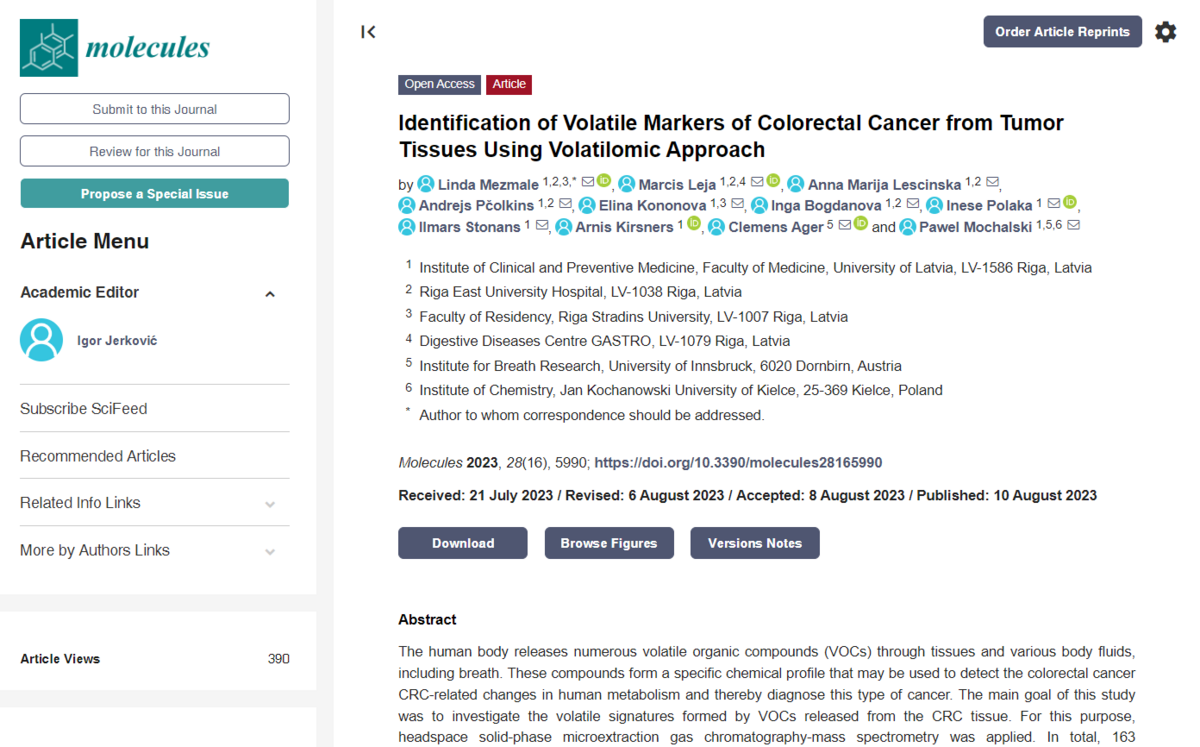
The authors of the article are LU KPMI researchers - Linda Mežmale, Mārcis Leja, Anna Marija Leščinska, Andrejs Pčolkins, Elīna Kononova, Inga Bogdanova, Inese Poļaka, Ilmārs Stonāns, Arnis Kiršners, in cooperation with Austrian researchers Pawel Mochalski and Clemens Ager from the University of Innsbruck.
The human body emits many volatile organic compounds (VOCs) through various body fluids, tissues, including exhalation. VOCs create a specific chemical profile that can potentially be used to detect a variety of diseases, including changes in human metabolism caused by colorectal cancer.
"The main objective of this study was to identify and investigate the VOCs formed in colorectal cancer tissue. For this purpose, gas chromatography-mass spectrometry technology was used," says Linda Mežmale, a researcher at LU KPMI and one of the authors of the study.
The study resulted in the identification of 163 compounds. Four VOCs (1-propanol, pyridine, isoprene, methyl thylacetate) were identified at increased concentrations in colorectal cancer tissues, while 11 VOCs were found at decreased concentrations in these tissues (2-butanone; 2-pentanone; 2-methyl-2-propanol; ethyl acetate; 3 -methyl-1-butanol; d-limonene; tetradecane; dodecanal; tridecane; 2-ethyl-1-hexanol; cyclohexanone).
The study results can be found in more detail at: https://www.mdpi.com/1420-3049/28/16/5990 or https://pubmed.ncbi.nlm.nih.gov/37630241/
"The results of the study provided evidence that the VOC profile is altered in colorectal cancer, which can potentially be used as a biomarker for the detection of colorectal cancer. Reliable identification of VOCs associated with colorectal cancer is essential to guide and adapt the development of advanced sensor technologies that can efficiently and sensitively detect these markers," emphasized L. Mežmale.

The project "Hybrid-sensor breath analysis for colorectal cancer screening" (abbreviated as HYCOR) is funded by the European Union. Its goals are to develop a mathematical model for the detection of colon and rectal cancer and to evaluate the sensor performance of a specially designed device for the detection of this disease. The scientific results of the project will provide new knowledge about the application of the hybrid breath analyzer in the detection of colorectal cancer. The obtained results will be important both for clinical practice in Latvia and globally. The studies of the Institute of Clinical and Preventive Medicine of the University of Latvia (LU KMPI) have shown promising results. This means that in the future, such an analyzer could be used in the diagnosis of various tumors of the digestive tract.
Project is co-financed by REACT-EU funding to mitigate effects of pandemic crisis
